
Remix the City
Once again, mobile apps are redefining how artists compose music. I stumbled upon this app the other day and immediately saw the potential in utilizing this technology for the CLE. The app is called Fresh Push Play, it was developed by W+K Tokyo Lab, HIFANA (a breakbeats duo from Tokyo that created the Nike Music Shoe) and Rhizomatiks. HIFANA launched the app by taking it to the streets of Tokyo and documenting their journey, collecting sounds of the city as they explored, until they reached their destination - a show with friends performed with only their iPhones and iPads.
Just imagine the potential for CLE. Can you imagine the song that we could create for Cleveland?

The Mashup Class
It was Richard Florida - author, professor and researcher, that coined the phrase "The Creative Class." A concept that identifies the essential elements required for urban revitalization: Technology, Talent and Tolerance - The three Ts.
Cities must invest in technology, nurture talent and be tolerant or accepting of diversity for creative people to come live, work and play. The growth and prosperity of a city is dependent on these attributes because they attract a unique group of people – The Creative Class. This concept fascinated me for the past six or seven years, it occupied many of my thoughts and influenced many of my actions during a time when I moved from Detroit to Boston to Cleveland.
Another concept that I've been following for the past few years is The Creator Class. Another set of three words enriched with alliteration: Creators, Communities and Companies - The three Cs. This concept was devised by Piers Fawkes of PSFK, it analyzes the intersection of these areas and how they affect culture.
Members of this community leverage digital distribution, thrive in niches, market via networking and collaborate. I found this concept particularly interesting when looking at the world of advertising, due to the creation of new agencies like Victors & Spoils, co: and Made by Many, and also open innovation groups like The PurpleList or Behance Network. However, it was another kind of Creator that attracted my attention and ignited my curiosity over the past few years: The mashup artist. People like Banksy, Poster Boy and Girl Talk, who blurred the lines of creation by mashing original and borrowed works to a point where the originator was indistinguishable and remixed everything, even culture.
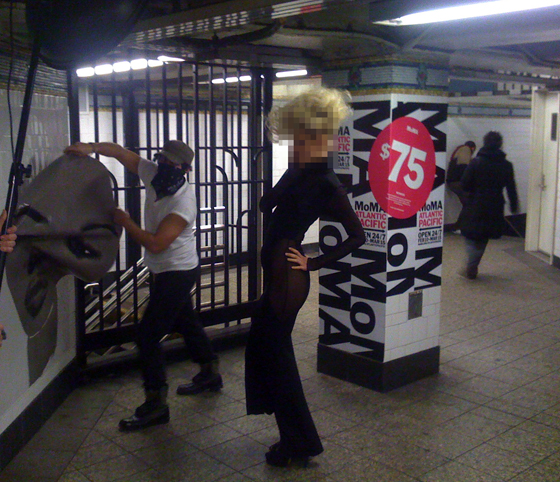
I am anxious for more artists to use multidisciplinary tools and harness the power of technology to remix our world and mashup production, consumption and distribution. And it's happening now, you are the artist and consumer.
Press Pause Play
Press Pause Play is a documentary that introduces the creatives at the frontier of production, the technical enablers of collaboration and distribution, the artists, the pop stars, the film makers, the business men, the visionaries and the ones left behind. Itʼs a story from the smallest molecule to the largest corporation. Itʼs a snapshot of today, but at the same time predictions of a near future.
A new generation of global creators and artists are emerging, equipped with other points of reference and tools. The teachers are not certified schools anymore - itʼs web sites, discussion forums and a “learn by doing”-mentality. We see the children of a digital age, unspoiled or uneducated depending on who you ask. Collaboration over hierarchy, digital over analog - a change in the way we produce, distribute and consume creative works. Press Pause Play is an amazing documentary that will inspire any creator or mashup artist.
Collaborate and Remix Life
Walking on Eggshells: Borrowing Culture in the Remix Age is a documentary about appropriation, creative influence, re-use and intellectual property in the remix age. It is a conversation among various musicians, visual artists, writers and lawyers.
Remix Everything
Remixing utilizes the techniques of copying, transformation and combining; with all creations infused with inspiration from another work. Everything is a Remix is a four-party documentary. At this moment, only three have been published:
The Future of Art & Ideas
This video from the New York Public Library features Larry Lessig, founder of Creative Commons and author of "Remix," Shepard Fairey, artist and founder of OBEY, and Steven Johnson, author of "The Invention of Air." This panel answers the question, "what is the future for art and ideas in an age when practically anything can be copied, pasted, downloaded, sampled, and re-imagined?"
The Mashup Class

After researching all of the sources above as well as many other reference materials, several key elements or trends were revealed. The idea that a breed of individuals exist that thrive in remixing and mashing up culture - The Mashup Class. And this is not limited to street art or music, it extends to the arts, business, technology and beyond. This culture has innate motivations and identifiable behaviors:
- Collaboration - Many people think that mash-up art is created by stealing, but it is actually the greatest collaboration between artist and the beholder. Collaboration is an action where creative inspiration adapts and evolves to create something new.
- Community - This is naturally created during collaboration, but also when the creator pays homage to those that inspired them
- Culture - Inherent in this practice is the association to pop-culture and act of borrowing cultural references as need to inspire or express. Cultural and historical references are your canvass and influencers are your inspiration and instruments. Crowdsource - Inspiration is not pulled from one, but many sources. Crowdsourcing is not always a visible action, but can be covert
- Openess - Transparency is not necessary, everything can be reverse engineered, whether purposely made available or not
- Defiance - In order to be innovative and creative, you must, at times, break the rules. And also, be willing to pay for the consequences
- Transform - According to copyright laws, the extent to which a work is deemed transformative will determine if the work is fair use. However, the expression and interpretation of art is native to the individual, the means by which language is translated or transformed from one to another. Originality is not a goal, plagiarism is not a fear, and authorship becomes unknown as the line between author and orignator is blurred.
- Instrumental - Technology has created an endless number of new tools and instruments for artists to use.
- Craft - Often the craft is learned through the process and individuals are self-made. Just as experise in the craft increases over time, so does respect for the craft
- Share - The old distribution model is dead, sharing works digitally is the new methodology for exposing others to your works
- Create - Be prolific and continue to remix and be creative
Art, Science & Technology in Music
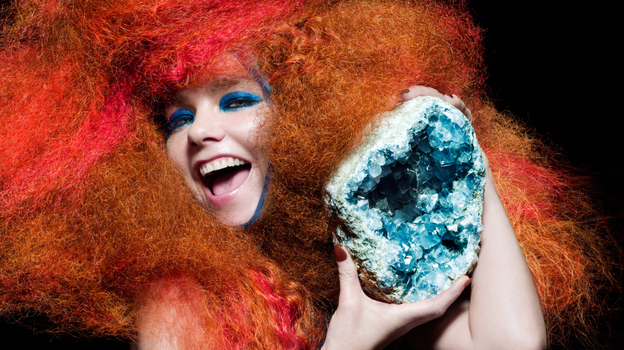
Bjork's latest album may be her most ambitious project yet. Biophilia is a collection of songs composed with the themes of nature, science and humanity infused. For preparation, Bjork researched astrophysics, string theory, neurology, biology and other domains where science and music collide.
Listen to Bjork "Biophilia" in its entirety here on NPR Music.

With this inspiration for Biophilia, Bjork then created a unique environment to experience the music. The Biophilia app immerses the user into an intricate galaxy, with ten different destinations, each representing unique songs. Each song is available to purchase and download in-app, for $1.99 each. According to the app’s release notes:
Biophilia is an extraordinary and innovative multimedia exploration of music, nature and technology by the musician Bjork. Comprising a suite of original music and interactive, educational artworks and musical artifacts, Biophilia is released as ten in-app experiences that are accessed as you fly through a three-dimensional galaxy that accompanies the album’s theme song Cosmogony. All of the album’s songs gradually become available inside Biophilia as interactive experiences, beginning with the first single Crystalline.
Download the Bjork "Biophilia" iPhone and iPad app here.
Read, learn and explore other digital music innovations in our series of posts called "A Digital Rolling Stone."
The Power of Two: Passion & Love

American Authenticity
Over the past few years, we have observed and experienced tremendous innovation and creativity throughout the Midwest. Many of these creative moments were cultivated or created by passionate couples. We spoke about this with our friends from Detroit, Perfect Laughter, over dinner in Cleveland several months ago. Around the same time, they wrote a series of blog posts called "A Couple of Questions" that highlighted many of these creative couples in art and design. Recently, we have noticed a similar trend in fashion, an increased focus on designing, producing and manufacturing in the USA; with the intrinsic values of quality and craftsmanship - American Authenticity.
Raleigh Denim
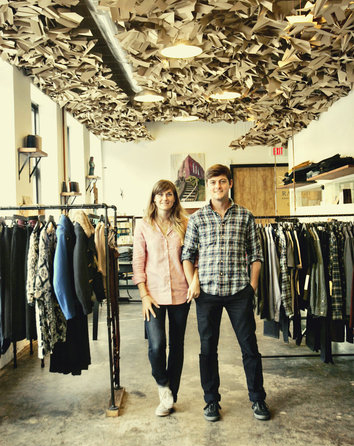
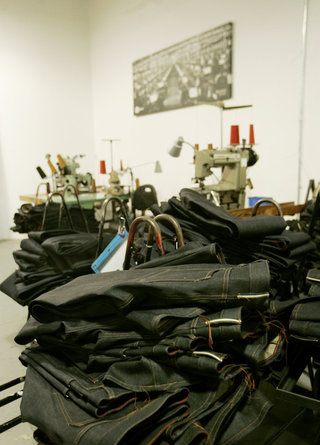
Sarah and Victor Lytvinenko met in high school and then attended North Carolina State University, where Sarah studied fashion and Victor business. Together they created Raleigh Denim to unite tradition and heritage with contemporary fit and style, all under one roof using locally and regionally sourced product. Their jeans are handmade in the United States at their Martin Street workshop, located in the revitalized district of downtown Raleigh.
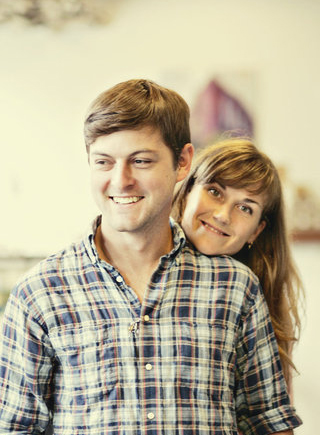
They have received press from Elle, Lucky, Esquire, Southern Living and Fast Company. And more importantly fashionistas demanding their jeans, which resulted in Barneys and Saks picking up the men's denim line. The contract with Barneys forced them to increase production and staffing, requiring them to take advantage of the Obama small business assistance stimulus plan to hire more staff, a total of 14 new local employees.
Imogene + Willie
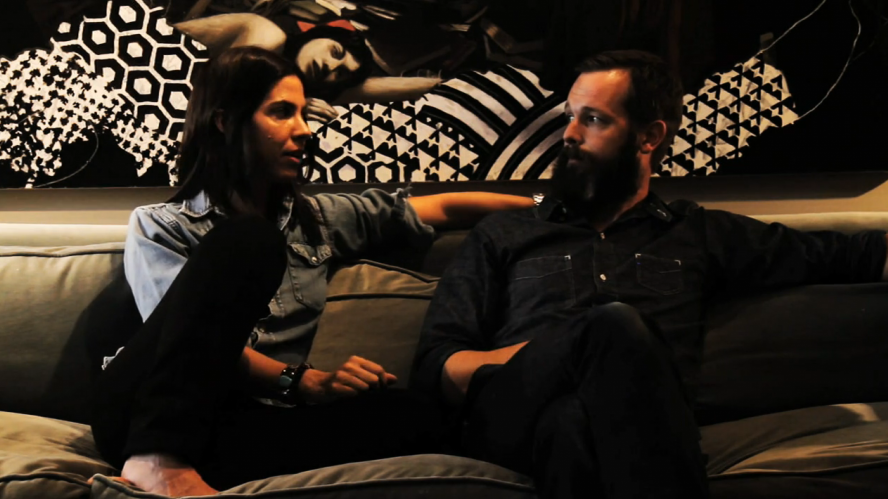
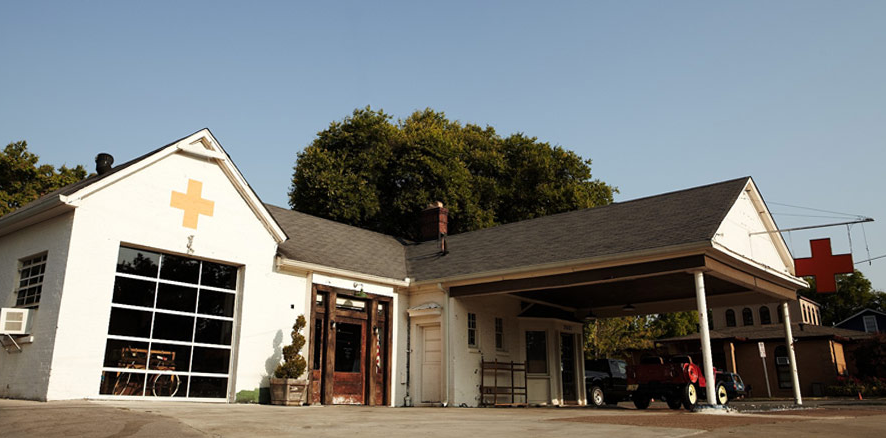
A big idea in the middle of the night, that was the beginning of Imogene + Willie, created by Carrie and Matt Eddmenson. Two childhood friends whose lives seemed to always bring them back together, fell in love and brought their passion for denim to life. They opened their workshop and store in an old gas station in Nashville, Tennessee. They have been receiving great press from musicians like Kings of Leon and Dan Auerbach of The Black Keys. Their beautiful story is best explained from their point of view in the video below.
United Vision and Ideals
After learning more about Raleigh Denim and Imogene + Willie, it was clear that they shared similar philosophies, which also contribute to their success.
- Craftsmanship: Meticulous attention to detail and intense respect for their craft. A level of expertise achieved only after years of study and practice; dedicating your heart to your work; blood, sweat and tears
- Quality: Utilizing the best materials and methods to compose their creations
- Responsibility: Understanding the need to design, produce and manufacture their works right here in the USA and support their local communities
- Sustainability: Utilizing locally and regionally sourced materials and understanding environmental, economic and social impact of their actions. Both Raleigh Denim and Imogene + Willie are housed in revitalized buildings and areas, supporting the rejuvenation of their communities
- Authenticity: Maintaining their unique mission and vision
- Style: Understanding the pillars and elements of fashion and infusing the authenticity of their brand and products
- Heritage: Drawing inspiration from and honoring the past, with a fond heritage for family, their craft and our country
- Passion: Emotional devotion to their craft and works
- Love: Relentless love for each other, their craft and community
The result of this model or philosophy in action is attainment of the American Dream - achieving personal and professional prosperity and success from owning and operating your dream, actualized by enacting your beliefs and principles.
The Statistics of Music
As titled, "The Evolution of Music," may not actually document the progression of music, but this video does illustrate music statistics in an engaging video infographic.
Video created by Simple Zesty. Photo via IRI5.
MIT Media Lab
Actively promoting a unique, anti-disciplinary culture, the MIT Media Lab goes beyond known boundaries and disciplines, encouraging the most unconventional mixing and matching of seemingly disparate research areas. It creates disruptive technologies that happen at the edges, pioneering such areas as wearable computing, tangible interfaces, and affective computing.
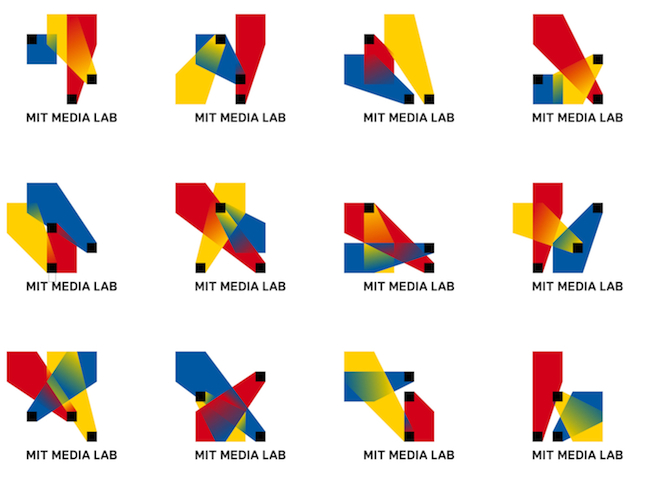
To honor 25 years of innovation, MIT Media Lab recently unveiled their brilliant new brand identity. The logo is built using an algorithm that creates 40,000 permutations with different shape and color combinations.
[hr align="center"]
Brand Identity
[hr align="center"]
Intentionally Passive Music Composition
Intentionally passive music composition has interested me for quite some time. This is the idea that we can create music by strategically planning for specific outcomes to create beautiful music; such as harnessing gravity, nature or the elements to create music organically.
One of my favorite recent examples of this is Conductor, which harnesses the NYC subway system and turns it into an interactive string instrument. Using the MTA's actual subway schedule, the piece begins in real-time by spawning trains which departed in the last minute, then continues accelerating through a 24 hour loop.
Read more about music composition in the digital age here.
2011 SXSW Interactive Festival Panel - VOTE!
Over a month ago I submitted a panel proposal to the 2011 South by Southwest (SXSW) Interactive festival and am pleased to announce it has been included in the PanelPicker voting process! The panel is called “A Digital Rolling Stone: Disruptive Technology & Music” and it will analyze the current digital ecosystem to reveal the disruptive technologies and methods that will revolutionize the way music is created and experienced in the future.
2011 PanelPicker Voting Has Begun!


To get started you first need to, create a free PanelPicker account. After that, give “A Digital Rolling Stone: Disruptive Technology & Music” a “thumbs up.” Voting will close on Friday, August 27th, so make sure you vote soon.
Hope to see you in Austin!
– Eric
A Digital Rolling Stone 3.0 - Composition in the Digital Age
Inspired Creation
In this installment of A Digital Rolling Stone, we analyze the composition and creation of music in the digital age. If you are a musician, you know that the process of composing and creating music is difficult, demanding and at times, frustrating. However, it is also exhilarating and inspiring; especially during collaboration or improvisation. Similar to many musicians, I love jamming with friends and creating something new - challenging myself to play something I have never played before or anyone has heard. In science, improvisation is experimentation; and musicians follow a similar scientific method:
- Define the musical challenge
- Consider and select instrumentation (or media)
- Hypothesize how the media will affect the composition and sound on a macro and micro level
- Perform the experiment by playing and reacting to pitch, rhythm, dynamics, visual movements and the mood
- Analyze the expression of logic and emotion
- Interpret sound and draw conclusions to create a new hypothesis
- Store in memory, perform live or record
- Practice
For me, I find step two to be the most interesting. The consideration and selection of instrumentation or the media that creates the layers of sound, is the point where true creativity is actualized. At MSU, my art professor showed us a documentary film on Fred Frith (an experimental musician and composer) called "Step Across the Border." The reason he showed us a film about music in art class was because Frith challenged the historical notion of music by reconsidering harmonies, melodies and instrumentation to create something creative and innovative. Beyond the known.
This approach may yield unusual or uncomfortable results, but if you embrace the unknown and explore, you will reach great heights. Some may view this form of creativity to be limited to artistic expression only and unable to reach commercial success. Depending on your aspirations, this may or may not be important to you. Regardless of your intentions, audiences will adopt artistic expression similar to the diffusion of innovation, such as in the case of art by Pogo with the visual, musical mash-up called Alice or his most recent creation, Gardyn. This art later inspired Craftsman allowing them to experience great commercial success with their contagious online video.
How does this notion apply to musical composition in the digital age? As a musician, it is important to understand how you can change your perspective and expose yourself to opportunities that may inspire you. From a commercial perspective, Craftsman was able to do this by taking inspiration from Pogo's art. Lastly, the ability to utilize available digital technologies as media, is essential in composing music in the digital age.
Art in Translation
Within the past 6 months, I have found several examples of digital music composition as art installation, such as 40 wild birds playing a Gibson Les Paul. This showcases how nature can provide new layers for instrumentation; other examples include the sun or even rain. These examples exhibit music composition in the digital age, however reveal an interesting and important insight - that idea that music can be composed passively rather than actively. Also, new layers of instrumentation using digital technology can also allow one to invent new instruments.
Digital Instrumentation - Intentionally Passive
The disciplines of science and technology with artistic expression converged in the mind of Kawase Kohsk when he created BEARINGS GLOCKEN, a musical instrument that automatically performs a glockenspiel using steel ball bearings. The music is created after calculating the relationship between the ball bearings and intentional path. An interesting note from the creator is that people "have fewer and fewer chances to experience live performance. These days we can even listen to music on mobile phones. But, I want people to know the richness, power, impact, and vividness of sound created right before your eyes."
Digital Instrumentation - Gestural Interactions with Sound
Back in the day when you wanted to start a band, you searched for friends that played guitar, bass, drums and someone that could sing. Now, all you need is your computer. In my eyes, this does diminish the creativity and spontaneity that comes from colliding musical visions between opposing artists, however technology has provided a new canvas with multiple dimensions. This can be as basic as a "simple sinewave synthesizer triggered by an ordinary 16 step sequencer," also known as the ToneMatrix. I found this synthesizer a while ago and became addicted. This synthesizer from aM laboratory by Andre Michelle, interprets user interaction and creates a revolving, dynamic wave of music. This idea is taken to the next level with the Artikulator, a multi-touch musical instrument created by "Mike Rotondo and Luke Iannini in about 24 hours during a Music Hackday, a series of events that combines art and technology with fascinating results" (via Mashable).
A new company called Liine, whose "aim is to redefine the way people interact with sound," has created a new digital instrument called Griid, an expressive and tactile live performance app for the Apple iPad, iPhone or iPod Touch. Imagine taking the ToneMatrix or Artikulator and mashing it with a turntable. According to this article, Richie Hawtin, a well-known Canadian DJ who has been influential in the Detroit techno movement, previewed Griid at the Movement: Detroit Electronic Music Festival before his performance. As mentioned earlier, improvisation is experimentation. And for a DJ, experimentation and adaptation is your platform for performance. Dynamic musical performances created by user interaction on the digital app Griid enables true improvisation during live performances.
Sadly, at the end of June, Hawtin reported that someone stole his Macbook, two iPads and iPod from his hotel shortly after announcing the Griid in Paris. No longer will thieves steal distortion pedals and guitars, but instead your digital, computerized instruments.
Digital Instrumentation - Physical Interactions with Sound
The Eigenharp is an electronic musical instrument that allows musicians to play and improvise via expressive physical interaction, creating a limitless range of sounds. According to the Eigenharp website, it "can play and record loops, change scale and key, transpose, alter tempo, program beats, create arrangements, switch and layer multiple sounds, all while the musician is performing live on stage."
This next example of physical interactions with sound is for entertainment value only, however very creative. This creativity allowed Nike to break outside of the norm and re-imagine what their shoes could be to create an analogy and communicate the essence of the product - freedom to just do it. Obviously these shoes do not make music when bent or twisted, but creativity, imagination and physical interactions allowed Nike to create an entertaining, contagious video that made many people wonder, how did they do that? And the video has received almost 800,000 views on YouTube.
Digital Instrumentation - The Algorithm
If Google created a musical instrument, it would be Tristan Perich's 1-Bit Symphony, an electronic composition in five movements on a single microchip. As described by Perich, though the composition is "housed in a CD jewel case, 1-Bit Symphony is not a recording in the traditional sense; it literally 'performs' its music live when turned on." Perich programmed and assembled the electronic circuit utilizing "on and off electrical pulses, synthesized by assembly code and routed from microchip to speaker, to manifest data as sound."
Digital Collaboration

All the examples presented showcase the vanguard of digital instrumentation. But how can we take these new methods and instruments and compose music in a way that would reflect the digital age? In a Wired article titled "Help Wired.com Crowdsource This Song" by Eliot Van Buskirk, we get a preview of a new musical environment that supports collaborative music creation online - Indaba.
When I lived in Boston, I was in an indie post rock band. We toured the midwest and eastcoast, everywhere from Boston to New York to Philly to Madison to St. Louis. We even recorded an album and released it on vinyl with a digital download. However, I moved to Cleveland and our lead guitarist, Danielle (Danielle was on my SXSW Interactive Festival panel "Big Brother in Your Brain: Neuroscience and Marketing") moved to Charlottesville. So that was it, our band broke up. However, if we could remove the barriers of space and time, we could play again. Many musicians have experienced this, and many have dreamed of Indaba. This new common ground for musicians, combined with the accessibility to musical inspiration worldwide, allows musicians to transcend many of the restrictions that have been in place for years. Let there be music.
A Digital Rolling Stone has sustained the hypothesis that IF the music industry wants to be profitable and relevant THEN the music industry must progress with and reflect culture while integrating technologies that create an augmented experience for the music enthusiast. The future of music composition is bright if musicians and inventors continue to work together and create new instruments like the examples mentioned above. All of these reflect cultural trends and integrate current technologies to expand instrumentation and further the advancement and innovation of digital music.
Unconsumption
Overview
When we were kids it was pretty much beaten into us that planet earth was in danger + the only way to save the planet was to "Reduce. Reuse. Recycle." Perhaps because we learned this at a young age it's second nature for us to want to limit the amount of "stuff" we contribute to landfills. In the rare instances where a recycling bin isn't near and we, frankly, don't feel like carry garbage around with us for hours, we toss that bottle into the trash with a healthy feeling of guilt. We know that not everything we throw away is "waste" - and our actions could be a lot less wasteful.
To this end, we've been thinking a lot about the idea of unconsumption and have been for quite some time now. During our trip to SXSW 2010, we had a chance to sit in on the panel of Dr. Nita Rollins from Resource Interactive to hear her perspective on "Digital’s Emerging Role In Unconsumption." Before we analyze and share insightful findings from Dr. Rollins, we will first beging with an analysis of "The Unconsumption Project" by Rob Walker, author of the New York Times column, Consumed; blog Murketing [The Journal of] and book "Buying In."
The Unconsumption Project
According to Walker, unconsumption is:
"a word used to describe acts of acquisition – generally, the acquisition of things, in exchange for money. Unconsumption is a word used to describe everything that happens after an act of acquisition. Unconsumption includes making things last, finding new uses for them, or, when they're used up, getting rid of them in the most responsible way. Lots and lots of thought and energy and money goes into creating “meanings” for consumption, but what about these unconsumption ideas? Can they be done in a meaningful way?
Walker further explains in his first NYTimes article on unconsumption that:
“Getting new stuff can feel really good. Most everybody knows that. Most everybody also knows ... that utility can fade, pleasure can be fleeting and the whole thought-that-counts thing is especially ephemeral. Apart from the usual solution to this problem (more new stuff!), it’s worth pondering whether getting rid of stuff can ever feel as good as getting it.”
Digital’s Emerging Role In Unconsumption
Dr. Rollins' panel focused on this topic mostly as it pertains to consumer behavior, both during + post-recession. Some interesting stats to put this into perspective: “Sales at Goodwill stores grew 7.1 percent in the first three months of 2009. Craigslist saw 100 percent increase in bartering. And companies began to launch campaigns to appeal to the frugal consumer, like the Babies 'R' Us trade-in where customers brought in old car seats for discounts on new goods” (via Huffington Post). You see the trend emerging...
For many, this behavior is mandatory. But, for others, it’s trendy. Remember all those celebrities and their plain white shopping bags a few years ago? How about this recent (more ironic) find. Nobody wants to be seen as a “have” in a world where most of those that make them successful are “have nots.” The same holds true for brands. But it’s not just an image play – what companies also have to deal with is how to stay profitable when their target audience seemingly can’t afford to buy their product. Dr. Rollins identified "Digital Forces" and "Consumer Actions" that support unconsumption. View the SlideShare presentation above for more details.
Digital Forces
- Radical Transparency
- Disintermediation
- Freeconomics
- Network Effect
- Dematerialization
Consumer Actions
- Reduce
- Reuse
- Recycle
- Refuse
- Make
- Sell
- Swap
Of these unconsumption forces and actions, it was interesting to hear Rollins assessment of the demise of greenwashing due to radical transparency. While we do agree, most organizations still have not completely adopted radical transparency and utilize selective transparency. However, as previously mentioned, Rollins' focus was about reaching the consumer, branding, and allowing that branding to do the heavy lifting of motivating that unconsuming consumer to action. Below are her suggestions for how to appeal to unconsumers:
- Clarify what you mean by “sustainability”
- Incorporate sustainability into your business’ operations, communications, and tactics
- Provide consumers with the option to rent rather than buy
- Think about selling “vintage” products
- Look to de-sanctify your packaging – understand it is trash if you don’t specify another use (i.e. art)
- Support swapping on-site
Even with the recession starting to soften, Dr. Rollins asserts that brands need to be aware that this trend is strong and, while it may diminish, certain brands will need to address this mindset present with their target audience for years to come.
Divergent Perspectives
There is one word that separates the beliefs of Dr. Rollins and Walker on unconsumption: brands.
From Walker:
"People can do what they want, I guess, but I should probably go on record as saying that it sounds to me like this version of “unconsumption” has nothing to do with The Unconsumption project that I’m involved in. My view, for the record, is that brands can’t “embrace unconsumption.” The last thing in the world that I had in mind with the Unconsumption project was coming up with some sort of shorthand that would help companies move more newly manufactured branded units. The unconsumption idea isn’t meant for brands, or people who make a living by burnishing brands. It’s meant for the rest of us. (via Murketing).
From Dr. Rollins
"...unconsumption...finding clever new uses for old, discarded, outmoded consumer goods--this is it. There were several of these uncanny flower pot cars in Uruguay's historic port town. Unconsumption is a trend known by many names, many of which begin with "re"--as in reuse, recycle, etc. The more inventive the reuse by the "unconsumer", if you will, or the more frequently a consumer releases her possessions into the ceaseless flow of capitalist goods so someone else can use and appreciate them, the easier her conscience about wanting something new. The environment is not the only beneficiary of this trend; so is the consumer on the receiving end of these repurposed, recirculated goods, if she is inclined to search for storied goods." (via Nita At Large).
With these two perspectives known, it is up to your subjective interpretation whether unconsumption can be used in branding. Maybe the case studies below can help you reach a conclusion.
Art & Music
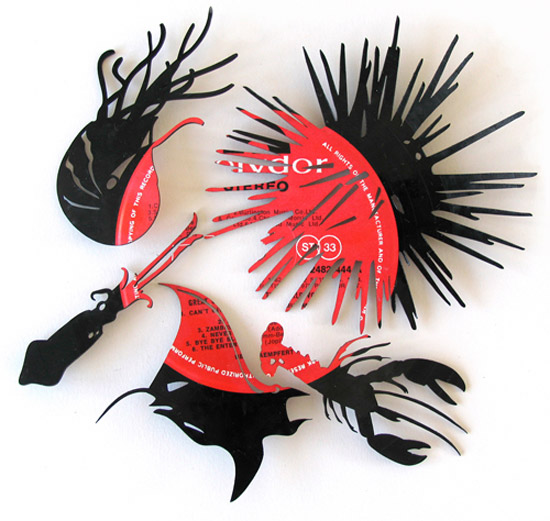
In researching our "A Digital Rolling Stone" project, we also found a few methods of unconsumption in the music industry. Vinyl jewelry from Cat Division.
Also, Atlanta-based artist Erika Iris Simmons (iri5), has been creating beautiful portraits of musicians and bands like Robert Smith and The Clash out of cassette tapes as part of her "Ghost in the Machine" project. Her reason for the medium: "The idea comes from a philosopher's (Ryle) description of how your spirit lives in your body. I imagine we are all, like cassettes, thoughts wrapped up in awkward packaging." We had the pleasure to trade art with Erika a few months ago, we gave her a vinyl LP record of Eric's band from Boston and she gave us an original composition created with paint and sheet music. Unconsumption can also create friendships.

Notebooks


Sorry Moleskin and Field Notes lovers, let us introduce you to your new crush. Anti-System Skateboard Notebooks made from recycled skateboards and Lego Notebooks made from recycled Legos.
Fashion
Wrath Arcane

One of our favorite clothing companies, Wrath Arcane: "WRATH ARCANE will be launching 'THE DREDGERS UNION' (*exact date TDB, likely summer 2010). This line will feature new mens and womens styles made from salvaged fabrics. Goods will retail for $65 - $75 for wovens/hoodies/bottoms, with the most expensive outerwear being around $195. All of the line will be MADE IN USA."
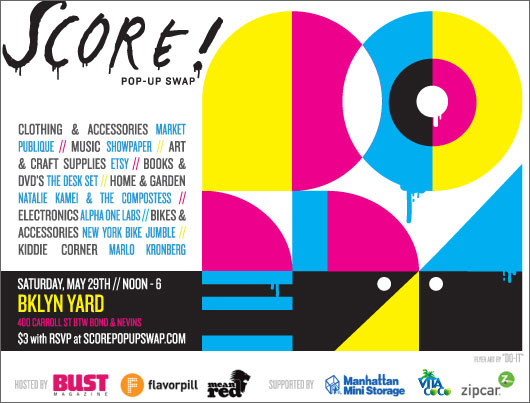
Score!
Score! is not your typical swap. In fact, it more closely resembles a pop-up free store: Attendees donate their goods, volunteers sort and display these items in themed “departments”, and attendees have the option to browse and take whatever they like… for free! It’s essentially a giant party — music, drinks, live screenprinting, photographers taking pictures of stylish “scored” outfits, etc. (via Score!)
Philanthropy
Hello Rewind
Hello Rewind, who has taken it a step further and woven in a philanthropic component. What they do: "Turn your old t-shirt into a custom laptop sleeve + support new life for sex trafficking survivors." There are certainly lots of companies/individuals that are finding ways to recycle clothing, we just happen to really dig the spirit + overall nature of this program.
Medwish International
Also on the non-profit tip, Medwish International keeps functioning medical aid equipment/supplies out of landfills and instead deploys goods to developing countries who are in need of such tools.
Matter of Trust
Perhaps the most timely example is Matter of Trust's efforts of recycling your discarded dog/cat/other animal fur to help absorb the oil leaking into the Gulf of Mexico. No business goal - this is purely non-profit, but nonetheless hugely important + impactful.
Health Insurance

The last industry that we expected to adopt the unconsumption mindset and methodology was insurance. However, health insurance and unconsumption is actually a perfect pairing. Recently, we received a direct mail piece from Anthem Health Insurance and were surprised to find a ecological message: "Take the go green eco-challenge and get weekly emails that will show you how to lead a healthier life. Plant this recycled postcard in shallow soil. Add water and sunshine. In six to eight weeks, enjoy wildflowers." A beautiful idea.
Furniture
A Piece of Cleveland (APOC)

APOC loves Cleveland. Its history, its character and its potential. APOC was created to preserve this rich history by telling a story and turning unwanted materials into something better than they were before. Every product that they offer is made from materials carefully extracted from office buildings, residential homes, churches, schools and other historical structures in the city. Countless people, maybe some who were our ancestors, have walked on, sat in, and used the materials that we are rescuing to create our products. By using durable and beautiful wood, glass and metals found in these buildings, legacies are allowed to live on.
Coca-Cola
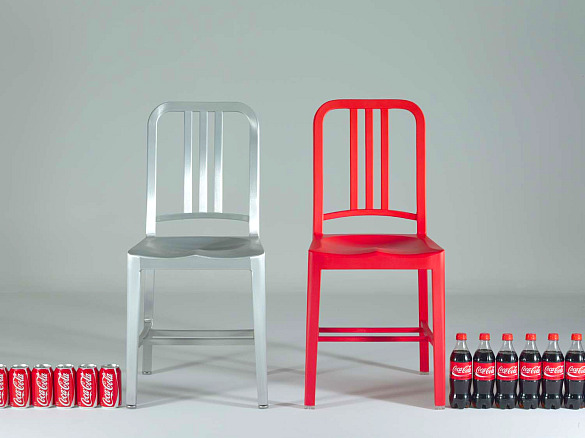
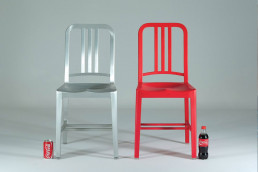
Technically, this case study exhibits the recycling of consumer product goods (CPG), however it also integrates a well-known furniture designer. Coca-Cola recently unveiled a partnership with Emeco to create a sustainable chair made out of recycled Coke cans and bottles (via Buzz-Beast). Each chair will be made out of rPET derived from 111 recycled plastic Coke bottles. The chairs will be available for sale in June 2010 in select retail locations worldwide and can also be ordered by sending an email to coca-cola@emeco.net. This initiaitve benefits both companies.
“The 111 Navy Chair is a reflection of our commitment to sustainability, constant innovation and originality in design. This latest addition to our line of rPET licensed merchandise underscores the fact that Coca-Cola bottles are valuable recyclables. It is another step in our vision to recover and reuse all of our bottles and cans.” Kate Dwyer, Group Director of Worldwide Licensing for The Coca-Cola Company.
Conclusion
Regardless of whether you believe unconsumption can be utilized in branding or not, it is a powerful movement. Unconsumption is creative thinking in action. It's a response to the needs of our ecosytem and a moral responsibility each of us has to ensure a sustainable future. And we can't get enough of it! If you've seen something interesting in the unconsumption vein, leave a comment so we can check it out.